Sign up
Give the office your details and it enrols you, usually within a day, and emails your sign-in. Chapter 1's reading below is free. Chapters 1 to 3 are USD 10 and chapters 4 to 12 USD 80, paid by card once the office has enrolled you.
Get started on your own
Five steps, in this order. Tick each one; your ticks stay on this device.
Sign up
In the Sign up box above give your name, your city, an email or WhatsApp number and your role at work. The academy office enrols you and emails your sign-in, usually within a day. There is no password: you sign in with a code sent to your email.
Sign in
Open https://aigp.samas.school on your phone or laptop. Press Continue with Google if your email is a Google account, or type your email and press Continue. On Check your email, type the 6-digit code and press Sign in. Bookmark the page: this is your classroom.
Do chapter 1
Watch the film (about 7 minutes), read the reading, do the two tasks and learn the day's terms. One chapter is one evening.
Check chapter 1
Take the check at the bottom of this page. Pass Easy, Medium and Advanced to know chapter 1 went in, then go on to chapter 2.
Pick an exam date
Most people need 60 to 90 hours over 10 to 12 weeks. Choose a month, write it where your alarm is, and register with the exam body when you are ready; the fee, the testing centres and the online option are on its site.
The films
One film, a chapter at a time, about seven minutes each. Every chapter opens with a chime and its number, the chapter buttons jump to one, captions show the words, and the player remembers where you stopped.
Chapter 1: What AI is, and why it needs governance
Definitions, the characteristics that make AI different to govern, the risks and harms, and the six principles of responsible AI. The exam asks you to know and to apply all four. Domain I, competency A · film about 7 minutes.
Read: chapter 1 in about ten minutes
What we mean by AI
Governance frameworks use one working definition: artificial intelligence is a machine-based system that, for a set of objectives a person gives it, takes in data and produces outputs such as predictions, recommendations, content or decisions that can influence real or virtual environments. Hold on to the shape of that sentence: inputs, objectives, outputs, influence.
Inside the definition sit families that behave differently and are governed differently. Rule-based systems follow instructions a person wrote; they are predictable and explainable, and they do not learn. Machine learning systems learn patterns from data. Deep learning is machine learning with many-layered neural networks, strong on images, speech and text, and hard to explain. Generative AI produces new content from a prompt: text, images, code, audio. Agentic AI takes actions toward a goal, calling tools and other systems, with less direct human control over each step.
Why AI is different to govern
Organisations have governed software for decades. AI needs its own approach because of characteristics ordinary software does not have, and the exam expects you to name them. Opacity: a model may give a good answer without anyone able to say why. Autonomy: it may act with no person in the loop. Speed and scale: one model makes a million decisions before lunch, so a small error becomes a large one. Probabilistic outputs: the same question can get a different answer tomorrow, and a confident answer can be wrong. Data dependency: the model is only as good, and as fair, as the data it learned from. Complexity: models, pipelines and vendors stacked on one another. And the potential for harm or misuse, from deepfakes to automated fraud.
Each characteristic is a reason a traditional control falls short. Code review does not catch a biased training set. A test plan written for deterministic software does not catch an answer that is right nine times in ten.
Risks and harms
Governance people sort harms by who is harmed. Individuals: a wrong or unfair decision, a leak of their data, a safety failure such as confident bad medical advice. Groups: bias, where a system performs or decides worse for people who share a trait such as gender, ethnicity, age or disability. Organisations: fines, lawsuits, lost customers, a damaged name. Society: misinformation at scale, power concentrating in whoever owns the largest models, the shock to work.
Underneath sit the causes the exam names: misalignment with the objective the organisation actually had; ethical failure; bias in the data; and scalability, which turns one mistake into thousands.
The principles of responsible AI
Across governments, standards bodies and companies the same principles keep appearing. Fairness: the system does not treat people worse because of who they are. Safety and reliability: it works as intended under the conditions it will meet, and fails safely. Privacy and security: it collects only the data it needs, protects it, and resists attack. Transparency and explainability: people know when AI is used, and a decision can be explained to the person it affects. Accountability: a named person or body answers for the system and its outcomes, and there is a way to question a decision and have it reviewed. Human-centricity: the system serves people, keeps them in control where it matters, and respects their dignity and rights.
Memorise the list, then practise applying it. Take any use case and walk the six principles through it before anyone writes code. Every line ends in a decision someone must take; deciding who takes those decisions is chapter 2.
Remember
- AI: a machine-based system that turns inputs into predictions, recommendations, content or decisions for an objective.
- Families: rule-based, machine learning, deep learning, generative, agentic.
- Why it is different: opacity, autonomy, speed and scale, probabilistic outputs, data dependency, complexity, misuse.
- Harms by who is harmed: individuals, groups, organisations, society. Causes: misalignment, ethics, bias, scalability.
- Six principles: fairness; safety and reliability; privacy and security; transparency and explainability; accountability; human-centricity.
The full chapter
Every idea in chapter 1 taken apart from first principles and explained simply, with exam traps, real cases and diagrams; flashcards; 50 practice questions with the reason for every answer; and a hands-on lab in Google Colab. Free.
Sort five systems you use
Write down five AI systems you meet in a week (a spam filter, a maps app, a chatbot, a camera filter, a loan or hiring tool). Put each in a family: rule-based, machine learning, deep learning, generative or agentic. Two of them will be hard to place; write why.
Walk the six principles through one case
Pick one AI use at your own workplace, or the hospital chatbot above. For each of the six principles write one question and the decision it forces. Keep the page; chapter 2 asks who takes each decision.
The terms
Seven terms a day for chapter 1: the word, its kind, a plain meaning, the sentence a scenario question would use it in, the Urdu, and what else it is called. Tap a card to turn it. Pick the day you are on; the page remembers it.
21 terms so far; each chapter adds its own. The academy app adds the quiz, the spaced repetition and your streak when you sign in.
The twelve chapters
The course follows the four domains of the exam's published outline (version 2.1, effective 2 February 2026), in its own words and with its own cases. Chapters 1 to 3 build the foundations, 4 to 7 the law and the standards, 8 to 10 development, 11 and 12 deployment. One chapter an evening, a timed check after each domain, a full timed exam at the end.
| # | Chapter | Domain | Status |
|---|---|---|---|
| 1 | What AI is, and why it needs governance | Domain I | Sample free; pack USD 10 |
| 2 | Setting expectations: roles, collaboration and the organisation | Domain I | Pack USD 10 |
| 3 | Policies across the AI life cycle and third parties | Domain I | Pack USD 10 |
| 4 | Data privacy law applied to AI | Domain II | Pack USD 80 |
| 5 | Other existing laws: intellectual property, non-discrimination, consumer protection, product liability | Domain II | Pack USD 80 |
| 6 | AI-specific laws: the EU AI Act, the Korean AI Basic Act, US state laws | Domain II | Pack USD 80 |
| 7 | Standards and frameworks: OECD, the NIST AI RMF, the ISO AI standards | Domain II | Pack USD 80 |
| 8 | Governing design and build | Domain III | Pack USD 80 |
| 9 | Governing data, training and testing | Domain III | Pack USD 80 |
| 10 | Release, monitoring and maintenance | Domain III | Pack USD 80 |
| 11 | Deciding to deploy and assessing a system | Domain IV | Pack USD 80 |
| 12 | Governing deployment and use | Domain IV | Pack USD 80 |
Share the academy
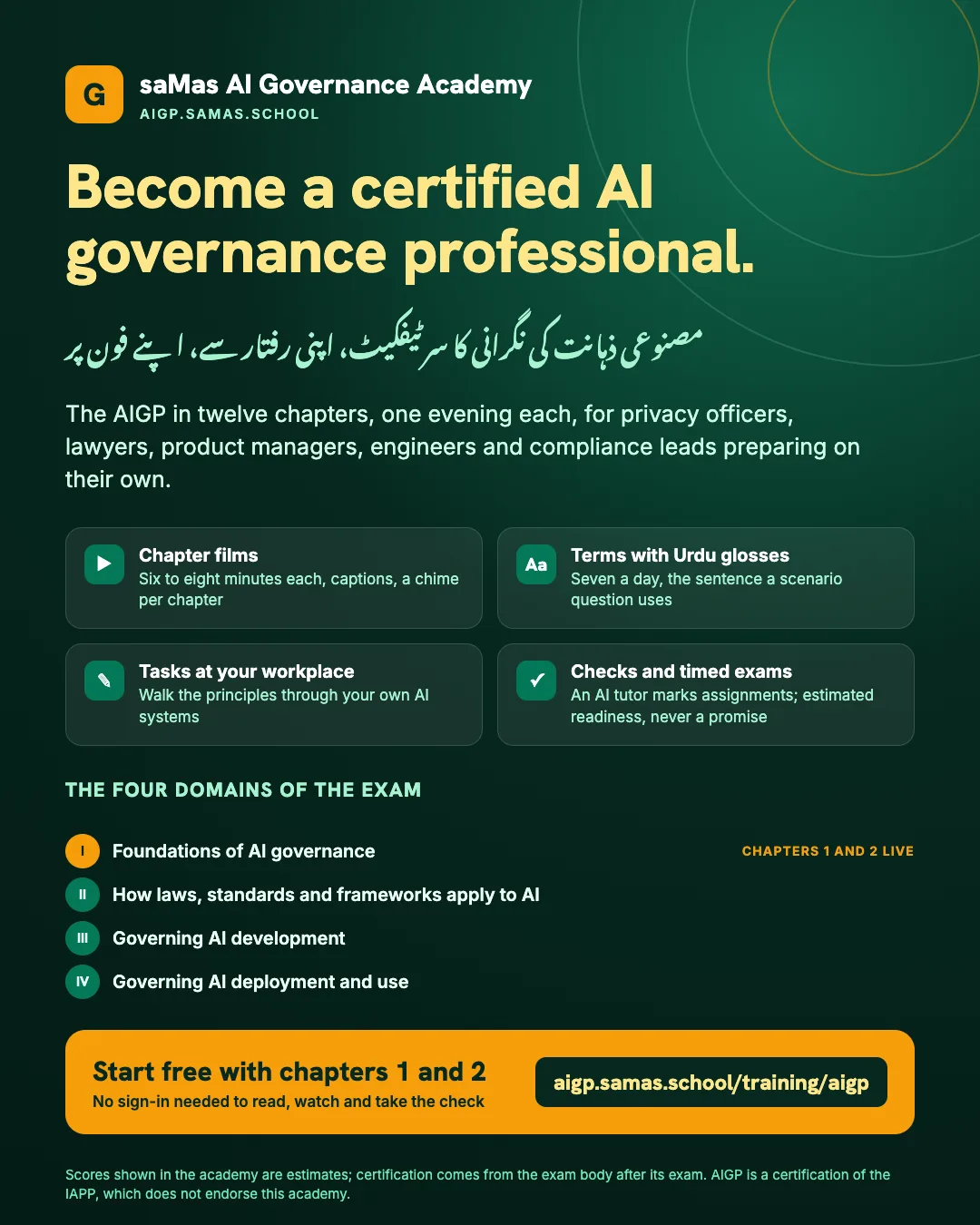
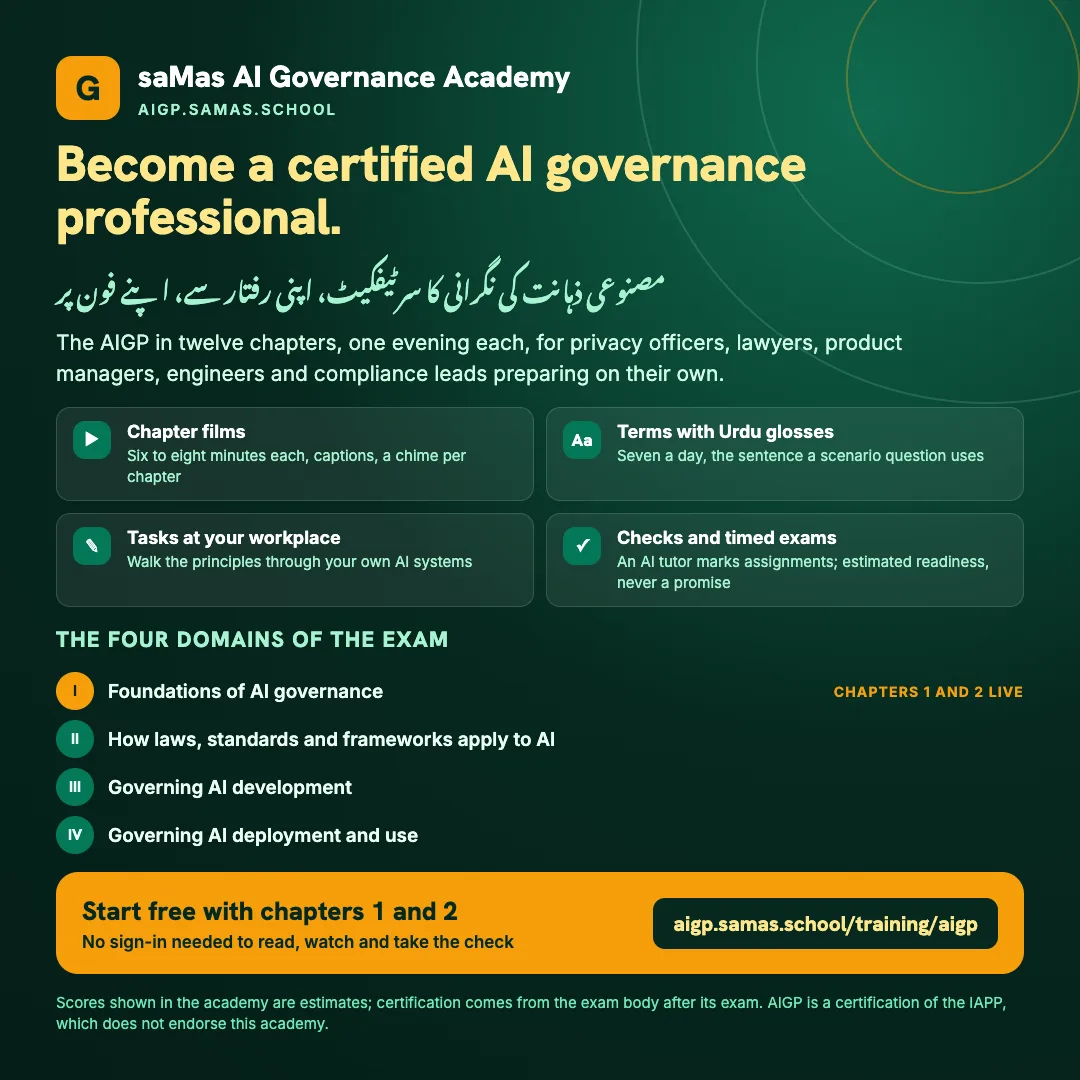
Two pictures to post or forward: one for a feed, one square for WhatsApp and profile pictures. Press and hold on a phone to save.
When something goes wrong
| You see | What to do |
|---|---|
| No email after signing up | Check spam and the promotions tab. If nothing arrives within a day, write to the office at the address in the footer with the name you signed up with. |
| The sign-in code does not arrive | Wait a minute and press Send again on the sign-in page. Codes are only sent to the email the office enrolled; a different address gets nothing. |
| The film does not play | Switch to Wi-Fi if you can. The chapter buttons jump to where you stopped, the captions button shows the words, and the reading below the film covers the same ground. |
| The check says Not yet | Read the answers it shows, open the reading for the questions you missed, and try again. Four of five opens the next level. |
| I want the certificate | This academy prepares you for the AIGP exam; the certificate comes from the exam body after you pass its exam. Nothing here is an official score. |
Report a problem
Signed in, press Feedback at the top of any screen or Report a problem next to an error, say what happened and press Send report; you get a reference and an answer within one working day. Not signed in: the sign-in page has a Report a problem link too.
Check yourself
Three levels of five questions on chapter 1: Easy for the ideas, Medium for applying them, Advanced for cases in the style of the exam. Pass a level with 4 right to open the next. Your answers stay on this device. These are the academy's questions, not the exam's.
The quiz needs JavaScript turned on.
Chapter 1 done
You passed all three levels. Take a screenshot of this card; chapter 2 is next. Your result is kept on this device.